
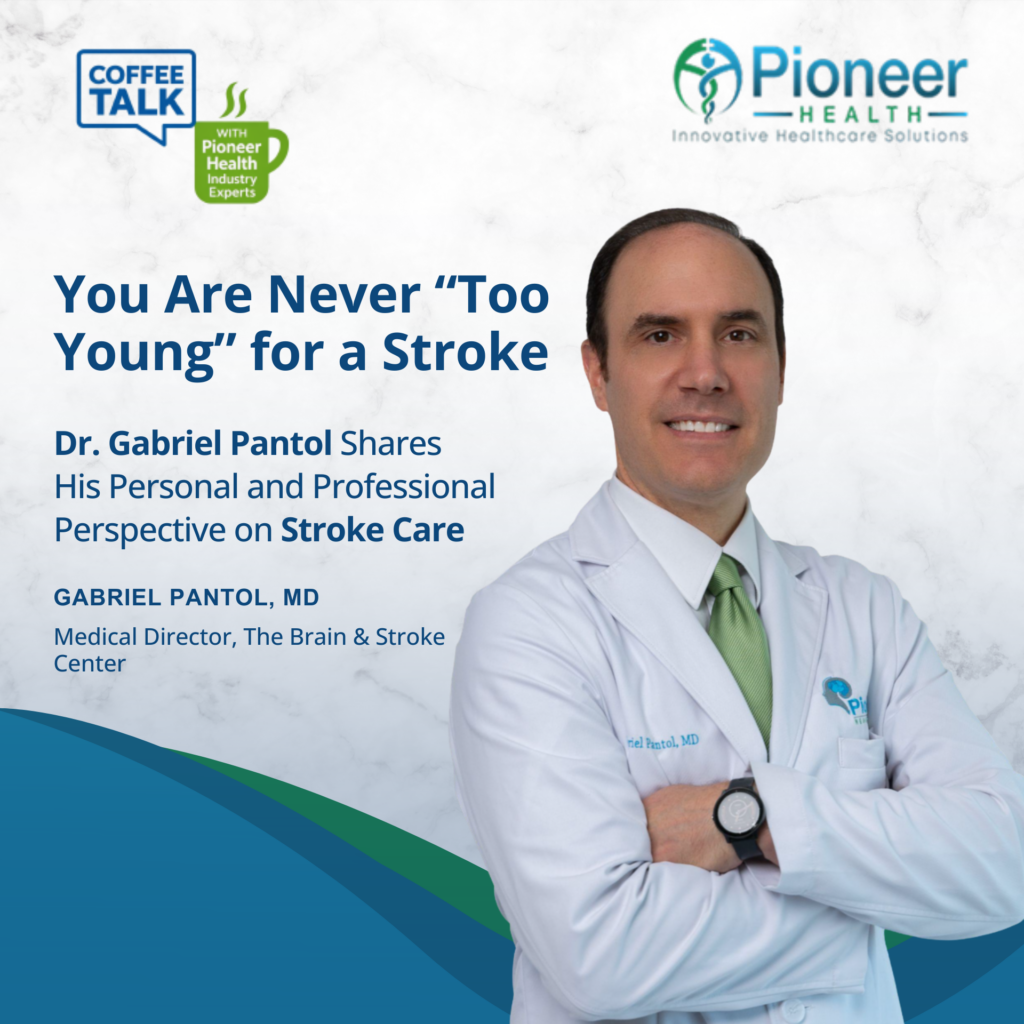
Dr. Gabriel Pantol Shares His Personal and Professional Perspective on Stroke Care
Stroke: A Medical Emergency at Any Age
By Gabriel Pantol, MD
For many Americans, the word “stroke” conjures a very specific image: an elderly patient, perhaps with a long history of high blood pressure or heart disease, suddenly losing the ability to speak or move. It is seen as a condition of age, something distant, something that happens to other people, older people.
That perception is not just outdated. It is dangerous.
Every year, I treat patients who never expected to experience a stroke, people in their 40s, 30s, and even 20s. Some of these patients are otherwise healthy. Some have no obvious risk factors. And yet, within minutes, their lives change in ways that can be permanent.
I know this reality not only as a neurologist, but as a patient.
At age 45, I experienced a stroke myself. I did not smoke. I did not have high blood pressure, diabetes, or high cholesterol. My stroke was ultimately traced to an undiagnosed heart condition, something I had no reason to suspect.
Fortunately, I was evaluated quickly, treated, and made a full recovery.
Not everyone is so lucky.
Misunderstanding is the Problem to Overcome
Public health campaigns have done a good job raising general awareness about stroke. Many people recognize warning signs like sudden weakness, difficulty speaking, or facial drooping. But awareness alone is not enough when it is paired with the wrong assumptions.
Too many people still believe:
- “I’m too young to have a stroke.”
- “This can wait. I’ll see if it improves.”
- “It’s probably something less serious.”
Those assumptions cost time. And in stroke care, time is everything.
A stroke is, in many ways, a “brain attack.” Just as a heart attack damages heart muscle, a stroke damages brain tissue. The longer the brain is deprived of blood flow, the greater the risk of permanent disability.
Minutes Matter More Than Most People Realize
In the hospital, we now have powerful tools to treat stroke, tools that did not exist just a generation ago.
Clot-dissolving medications can restore blood flow if administered quickly. In certain cases, we can perform a procedure known as a thrombectomy, physically removing the clot from a blood vessel in the brain.
Advanced imaging allows us to make rapid, informed decisions about treatment.
But all of these interventions depend on one critical factor: how quickly the patient seeks care.
If a patient arrives too late, the window for many of these treatments closes. What might have been a reversible event suddenly becomes a lifelong disability.
That is why one of the most important messages during Stroke Awareness Month is also the simplest: if you suspect a stroke, seek immediate medical attention. Do not wait.
Stroke Is More Disabling Than Many Expect
When people think about medical emergencies, heart attacks often come to mind first. But stroke can be just as devastating, and in many cases, more so.
A patient who survives a heart attack may return to a relatively normal life. A patient who suffers a severe stroke may lose the ability to speak, walk, or live independently. And once lost, those abilities may never be regained.
Families are often unprepared for the long-term impact.
This is not just a medical issue. It is a quality-of-life issue. It affects families, caregivers, and entire communities.
Risk Factors Still Matter, But They Don’t Tell the Whole Story
There are well-established risk factors for stroke: high blood pressure, diabetes, high cholesterol, smoking, and excessive alcohol use. Addressing these risks remains one of the most effective ways to reduce the likelihood of stroke.
But as my own experience illustrates, risk factors do not tell the whole story.
We are seeing strokes in younger patients and in people who do not fit the traditional profile. In some cases, the cause is a structural heart issue. In others, it may be related to blood-clotting disorders or other underlying conditions.
The takeaway is not that prevention doesn’t matter; it absolutely does. The takeaway is that no one should assume they are immune.
The Gaps Don’t End at the Hospital
Even when patients receive timely treatment, another challenge often emerges after they leave the hospital: fragmentation of care.
Patients may be treated for a stroke in one facility, then discharged and referred to outpatient providers who do not have immediate access to their records, imaging, or treatment history. Medications may be unclear. Follow-up plans may be incomplete.
This lack of continuity can delay recovery and increase the risk of complications.
For patients, the expectation is simple: the same level of coordinated care they experienced in the hospital should continue after discharge. For healthcare systems, delivering that continuity remains an ongoing challenge.
There Is More Reason for Hope Than Ever Before
Despite these challenges, there is real progress to point to.
Over the past 25 years, advances in neurology have transformed how we diagnose and treat many conditions that were once considered untreatable. Stroke care is no exception.
From imaging technology to interventional procedures, we now have tools that can dramatically improve outcomes. But we must use them in time.
That is the key. Science is advancing. The treatments are improving. But the outcomes still depend on what happens in those first critical moments.
If there is one message I would emphasize during Stroke Awareness Month, it is this: Stroke can happen to anyone. At any age. At any time.
And when it does, every minute matters.
Recognizing the signs and acting immediately can mean the difference between recovery and permanent disability. It can mean the difference between returning home and requiring lifelong care.
It is not an overstatement to say that fast action saves brain function and lives. The misconception that stroke is someone else’s problem is one we can no longer afford to carry.
About the Author:
Dr. Pantol is the Stroke Medical Director at AdventHealth Dade City and Zephyrhills. He also serves as the Medical Director of The Brain & Stroke Center in Wesley Chapel. He is board-certified in neurology and completed a neuromuscular fellowship.